The Evolution of Care Framework
JK
What Healthcare Gained. What It Lost. Where We Are.
I've spent thirty years inside healthcare — as a Chief Experience Officer at Yale New Haven Health, NYU Langone, and Humana, and now as a founder building AI workflow tools for the industry I know best.
But healthcare found me long before I found it. My father's illness made me a patient family member first — a child watching a system do its best and still fall short.
In all that time I've watched healthcare reinvent itself repeatedly. Each reinvention solved a real problem. Each one created a new one.
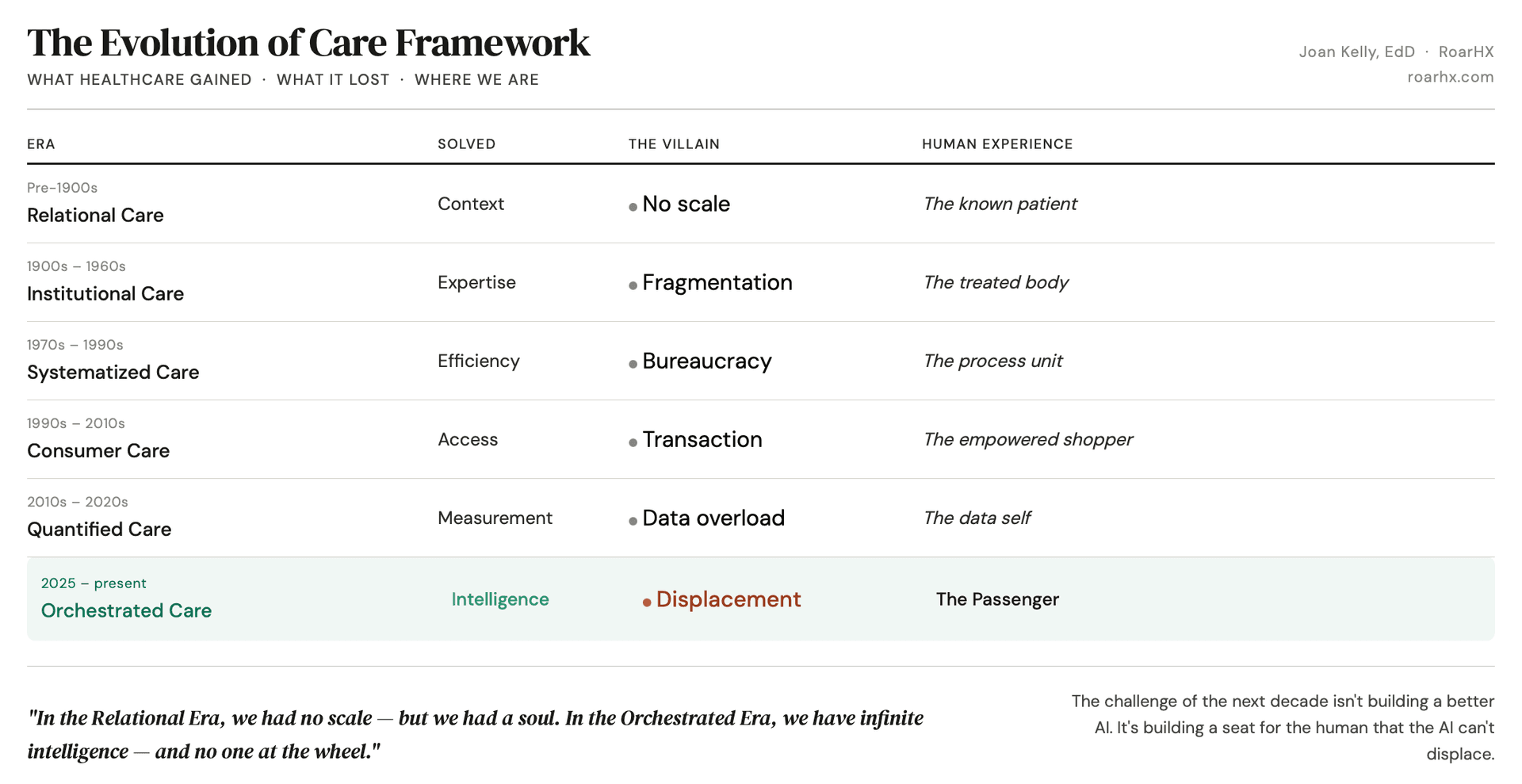
What I’ve come to understand is that healthcare hasn’t evolved randomly. It has moved through distinct eras — each with a clear promise, a hidden cost, and a defining human experience.
I call this The Evolution of Care Framework.
Relational Care
The era of the known patient — Pre-1900s
Once, healthcare was personal because it had to be. The doctor knew your name, your family, your story — not because of a philosophy, but because there was no other way. House calls. Bedside manner. A relationship built over years.
But its virtue was also its limit. Relational care could not scale. It reached those within walking distance and left everyone else beyond the hill.
The villain: No scale.
Institutional Care
The era of the treated body — 1900s – 1960s
The hospital became the cathedral of medicine. Expertise concentrated. Specialization multiplied — the heart here, the lungs there, the brain in its own wing.
This era solved for scale. But the cost was fragmentation. The patient became a collection of organs, each assigned to a different expert. No one held the whole story. The body was treated. The person was lost.
The villain: Fragmentation.
Systematized Care
The era of the process unit — 1970s – 1990s
If fragmentation was the problem, process was the answer. Protocols. Pathways. Managed care. The system learned to standardize, to measure, to optimize.
Efficiency soared. Variation dropped. But somewhere in the machinery, the human moment got scheduled out. The patient became a process unit — a set of tasks to complete, boxes to check.
The villain: Bureaucracy.
Consumer Care
The era of the empowered shopper — 1990s – 2010s
The system had become efficient but impersonal. So the pendulum swung. The patient would now be a consumer. Choice. Satisfaction scores. Hospital ratings. You could shop for your care like you shopped for a car.
This era solved for access — for those with resources. But it turned health into a transaction. The relationship became exchange. And those who couldn’t shop were left at the curb.
The villain: Transaction.
Quantified Care
The era of the data self — 2010s – 2020s
Before the next era could arrive, something had to be built: the data infrastructure. Wearables. Portals. Genomics. The patient began generating data constantly — steps, sleep, labs, clicks.
This wasn’t yet a new model of care. It was the bridge. It solved for measurement. For the first time, we could see ourselves in numbers. But the numbers multiplied faster than sense could make of them.
The villain: Data overload.
Orchestrated Care
The era of the passenger — 2025 – present
And so we arrive here.
The Orchestrated Era solves for intelligence. Agentic AI coordinates across every surface — scheduling, triage, documentation, diagnosis. Ambient intelligence listens in the exam room. The system acts on your behalf, seamlessly, continuously, invisibly. It knows you better than you know yourself. It predicts what you need before you ask.
It orchestrates everything.
And that is precisely the danger.
The villain of the Orchestrated Era is Displacement — the slow, seamless experience of being moved out of your own health story. The system doesn’t replace you. It just doesn’t need you. Your judgment, your preferences, your presence become optional.
You are still in the vehicle. You are still present. You are still, technically, the patient.
But you are no longer the driver.
You are the Passenger.
The Question That Remains
Every era solved the problem before it. And every era created a new one.
In the Relational Era, we had no scale — but we had a soul.
In the Orchestrated Era, we have infinite intelligence — and no one at the wheel.
The challenge of the next decade isn’t building a better AI.
It’s building a seat for the human that the AI can’t displace.