
AI Is a Multiplier, Not a Verdict
JK
What the new Ramp/Revelio data really tells us about AI and jobs — and the part most people are about to skip.
This week you'll see a wave of posts with some version of the same headline: AI isn't killing jobs after all. They'll be pointing to a new study from Ramp and Revelio Labs, and the study deserves the attention. But the headline is the least interesting thing in it.
Here's what the researchers did that's worth pausing on. Instead of asking companies how they feel about AI, they linked observed AI spending — actual card and bill-pay data — to workforce records across more than 21,000 U.S. companies. Spending is harder to perform than sentiment. When a measurement is expensive to fake, I pay attention.
The finding everyone will quote
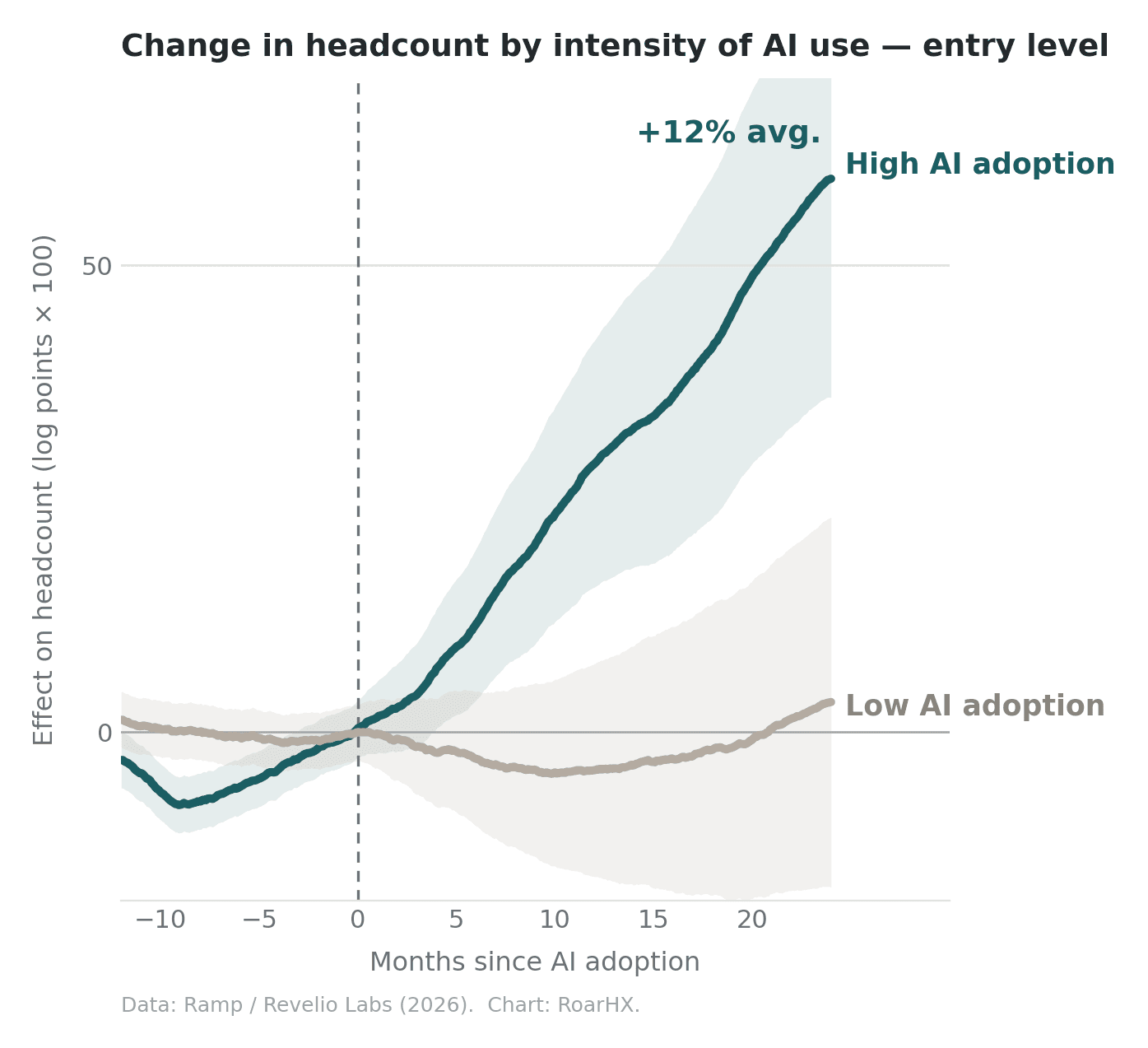
Firms that adopted AI most aggressively grew their headcount about 10% over two years. Entry-level roles — the ones we've been told are first on the chopping block — grew even faster, around 12%. And the growth wasn't walled off in one corner of the org chart. It showed up across engineering, sales, administration, customer service, finance, and marketing, with the strongest gains in the information sector.
If you stopped reading there, you'd walk away believing AI is a jobs engine. Please don't stop reading there.
The fine print that matters more than the headline
Three things in the methodology change the story.
The gains went to the committed, not the curious. The lift appeared only for high-intensity adopters — firms spending roughly $30 per employee per month on AI in their first three months — and even for them, not until 6 to 12 months in. The companies that bought a subscription, ran a pilot, and called it a transformation saw no measurable change. AI rewarded conviction, not curiosity.
The winners were already winning. The firms that grew were larger, faster-growing, and more engineering-heavy before they spent anything on AI. That's a selection effect, and it's a big one. We may be watching strong companies get stronger, with AI as one more accelerant — not AI lifting the average company.
This is a tech-forward slice of the economy, over a short window. The dataset skews toward software and tech-adjacent firms, and it only runs two years. Look at a wider cross-section and the picture darkens: other research has found AI erasing on the order of 16,000 net jobs a month over the past year, with younger and entry-level workers carrying the weight. Both things can be true. The Ramp data describes a specific population under specific conditions. It doesn't repeal the rest of the labor market.
So what is the real finding?
Not that AI creates jobs. The honest reading is narrower and, to me, more useful:
AI multiplies the decisions a company was already making.
A firm built to scale, with the appetite to reinvest productivity gains into more output, used AI to grow. A firm built to cut, or one that treated AI as a line item rather than a capability, got cutting — or got nothing. The technology didn't decide the direction. It amplified one that was already set.
This is the thesis I keep returning to in my own work, and I'll name it plainly: the Human Middle. In any AI system, humans remain the design authority. The model doesn't choose whether AI expands an organization or hollows it out. People do — through strategy, through governance, through what they choose to do with the time and cost the technology gives back. This study is one more dataset confirming that the outcome lives in the middle, with us, not in the tool.
Why this matters in healthcare
In health systems, the stakes on that middle are higher than almost anywhere.
Deployed one way, AI lowers the cost of documentation, coordination, and clinical busywork — and a system that's wired to reinvest can turn that recovered capacity into more care: more time at the bedside, more roles, more reach into communities that have been waiting. Deployed another way, the same tool becomes a quiet justification for trimming the workforce and absorbing the savings, with the patient experience flat or worse.
Same technology. Opposite outcomes. The difference isn't the model. It's whether leadership treats AI as a platform for ambition or a lever for subtraction — and whether the governance exists to make that an intentional choice rather than a default.
The Ramp data won't settle the AI-and-jobs debate; no two-year window can. But it does hand us a quieter, more durable point. The tool isn't the story.
What we decide to do with it is.
https://ramp.com/data/ai-jobs-impact